
District cooling
As global temperatures continue to rise and the demand for cooling energy increases, we must seek cleaner solutions to cool our buildings and cities. District cooling is a promising option to harness free cooling from sea water and air. It can efficiently cool entire communities from a centralized chiller plant and provide free cooling to large geographical areas. By eliminating the need for individual chillers in every building, district cooling can significantly reduce environmental impact.

Why Alfa Laval in district cooling?
- Alfa Laval has been a pioneering force in plate heat exchangers for almost a century, leading the industry in innovation and sustainability.
- We recognize the growing importance of district cooling and have developed solutions specifically tailored to your needs.
- Our heat exchangers excel in district cooling, saving costs, enhancing energy efficiency, and providing superior cooling performance.

How district cooling works
District cooling efficiently distributes cooling water from a centralized substation to local buildings using heat exchanger technology. The heat exchangers have two main purposes: Optimizing energy use by controlling water consumption and acting as pressure-breakers to control damage in case of leaks.
The substation consists of a control unit, control valve, and heat exchangers. The control valve regulates water flow, while the heat exchangers modulate the temperature and capacity for each building. An energy meter measures flow rate and temperature to calculate water consumption and final billing.
Free cooling from river or sea water
Utilising sea and river water for free cooling saves significantly more energy than traditional chillers. It also reduces the use of harmful refrigerants and fossil fuels, making it an environmentally friendly alternative.
Alfa Laval's plate heat exchanger technology is the ideal solution for safely utilizing various water sources, as it isolates the chilled water loop from sensitive equipment, eliminating the potential for corrosion, scaling, or unwarranted maintenance. The compact design of our plate heat exchangers offers more efficient cooling with minimal fuss.


Excess heat in chiller plants can save money and decrease carbon footprint
A chiller plant's primary function is to produce cold, but it also generates excess heat as a by-product. Reusing this excess heat is a great solution for space heating and domestic hot water, as it reduces fossil fuel consumption and energy bills at the same time.
Absorption chiller – produce efficient cooling from heat
In settings where district heating and excess heat are released at elevated temperatures, a heat-driven absorption chiller can provide efficient cooling. With this approach, you have access to free cooling from your existing process without depending on water as your cooling source. This reduces your electricity usage and conventional refrigerant consumption.
How an absorption chiller works
Inside the evaporator, refrigerant absorbs heat from the connected system, and a heat exchanger helps cool the air conditioning circuit. The refrigerant then enters the absorber in the form of low-pressure vapor, which is absorbed by a liquid solvent (usually lithium bromide).
A pump increases the pressure of the refrigerant, before it proceeds to an interchanger, where it is preheated (often using a plate heat exchanger). The resulting high-pressure vapor is then directed to the condenser, where heat is released during the refrigerant's condensation process.

Consultant? System integrator?
Are you a consultant? Look here! With expertise from decades of experience in heat exchange, Alfa Laval offers knowledgeable resources for today’s heating and cooling challenges. Discover answers to complex questions on everything from energy efficiency to natural refrigerants, along with helpful tools that make it simpler to find the right technology for your application.
AHRI-performance-certified heat exchangers for confident thermal performance
Certification from the Air-Conditioning, Heating, and Refrigeration Institute (AHRI) is the only global third-party verification of thermal performance, giving you independent assurance that your plate heat exchanger will perform in accordance with the manufacturer’s published ratings. Alfa Laval offers AHRI-certified gasketed plate heat exchangers, brazed plate heat exchangers, and fusion-bonded plate heat exchangers.
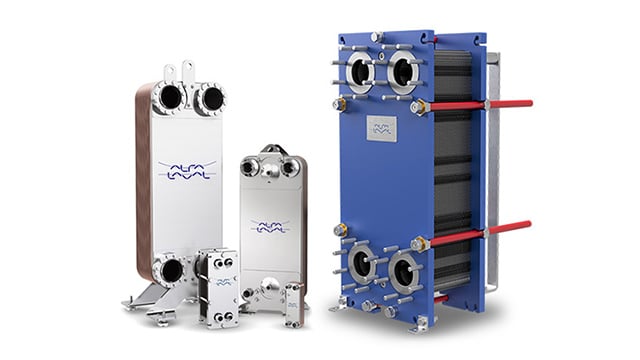
Gasketed plate-and-frame heat exchangers
- Flexible solutions that can be adapted to the duty ensuring highest thermal efficiency
- Compact designs save space and are easy to service and maintain
- Solutions to reduce fouling, stress and corrosion for maximum uptime
Brazed plate heat exchangers
- Lightweight copper-brazed construction with compact footprint
- Greater thermal efficiency than comparable shell-and-tubes
- Flexible options to fit a variety of applications with all different types of media/fluids
- Ideal for natural and low-GWP refrigerants
Fusion bonded AlfaNova heat exchangers
- True 100% stainless steel construction
- Strong corrosion resistance with aggressive media
- Prevents metal contamination in drinking water and other hygienic applications
- High thermal efficiency and compact footprint
Case story

Keeping The Louvre and Mona Lisa cold
Over the years, Alfa Laval has become a true partner and has contributed, thanks to its expertise and technology, to the performance of the Climespace energy network, which is the first district cooling system in Europe and one of the biggest in the world."
Jean Levezac, Head of Cluster Connections/Substations at Climespace Engineering
Efficiency that lasts for decades
The condition of your heat exchanger affects safety, product quality, and energy costs. Failures lead to downtime and production losses. But, with regular and proactive maintenance, performance is preserved and operations are kept trouble-free and predictable.
We have the expertise to help you, whether you experience a problem today, wish to prevent future issues, or want to solve the problem yourself with our online troubleshooter.