
Immersion cooling for high-capacity data centers
As energy demands rise, immersion cooling provides uniform thermal performance, improved efficiency, and supports higher-density computing.
Data centers worldwide have adopted immersion cooling due to its scalability, thermal stability, and support for high-performance computing. Advantages include:
- Eliminate hot spots for uniform thermal performance
- Operate at higher temperature tolerances
- Lower PUE (Power Usage Effectiveness) and CUE (Carbon Usage Effectiveness)
Thermal management across the entire system
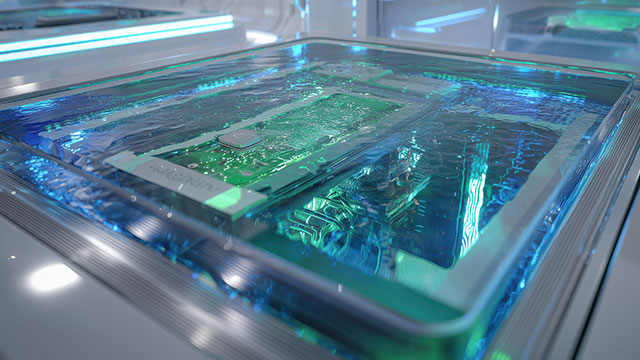
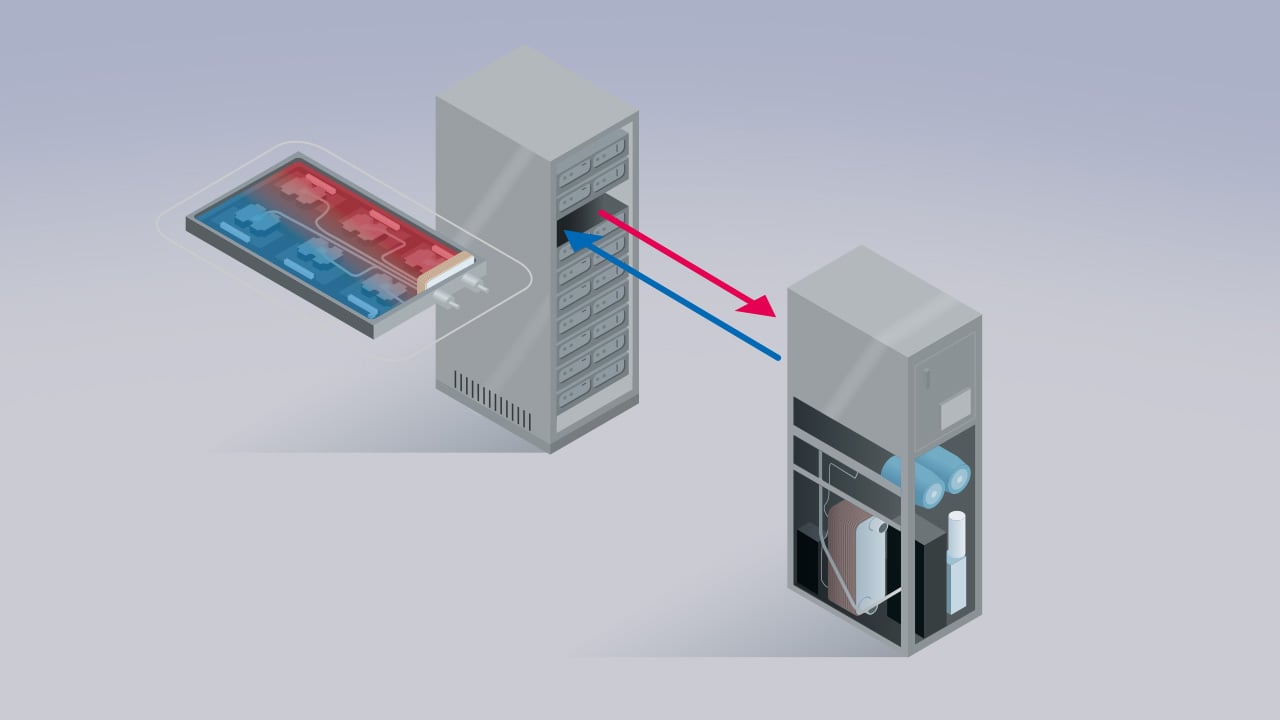
Immersion cooling works by submerging servers in a dielectric fluid. The liquid surrounds the entire system, eliminating hot spots and efficiently transferring heat from all components. The heated liquid is circulated to a heat exchanger, cooled, and returned to the tank, offering one of the most thermally effective solutions for high-density data centers.
Methods of immersion cooling
Immersion cooling can be deployed in different ways, each offering distinct advantages based on density, efficiency goals, and operating requirements.
Single-phase immersive tub
Entire racks of servers are submerged in a tank of dielectric fluid. Heat is absorbed and circulated out for removal, keeping performance steady. This method:
- Cools large groups of servers at once
- Reduces reliance on fans and CRAC units
- Enables easier maintenance with accessible, rack-level design
Two-phase immersive tub
Servers are submerged in a dielectric liquid that evaporates into vapor as it absorbs heat. The vapor then condenses back to liquid in the heat exchanger. This method:
- Removes more heat through phase change
- Manages extreme AI and HPC workloads
- Delivers maximum efficiency